Few buyers are clamoring for another adtech term or acronym to decode, and rightly so — our industry is full of them. But while “containerization” has been part of modern cloud infrastructure for years, it’s been showing up more often in conversations about how to optimize campaigns, so it is worth taking some time to understand.
As the name implies, a container is a secure, portable, and isolated way of packaging custom and/or machine learning models for deployment in a number of environments. At OpenX, containerization gives buyers a secure way to bring decisioning closer to supply, where valuable signals first appear, so bid requests can be shaped earlier, with less latency, less compute waste, and more targeting parameters from the start.
Why the Traditional Bidstream Creates Waste
Programmatic has always rewarded speed, but speed alone does not translate to efficiency gained. In the traditional auction, a media owner makes an ad opportunity available, the SSP applies basic rules like pricing floors, exclusions, and routing logic, and the request is sent downstream for DSP evaluation, all of which happens in milliseconds. From there, the DSP decides whether the opportunity matches the buyer’s audience, budget, pacing, creative, and performance goals.
The problem is that many requests never make it that far. DSPs manage infrastructure and cost through QPS limits, which means they can only process a certain volume of bid requests at any given time. So the bidstream is already being shaped, even when buyers have no control over how it happens.
This creates two issues for buyers: 1. missed opportunity and 2. wasted attention. Some valuable impressions may be filtered or deprioritized before they reach the DSP, while others that do make it through may be technically valid but still low value: the wrong audience, wrong context, wrong device, or low likelihood to convert. According to the latest findings, 8.5% of paid ad traffic is invalid, equal to $63 billion per year in wasted spend — and that doesn’t account for all the impressions that simply don’t align with a buyer’s goals.
If the bidstream is going to be shaped anyway, buyers should have more influence on making it work in their favor. With custom decisioning, they do.
What Is Custom Decisioning?
Custom decisioning is the capability to deploy a buyer’s proprietary models, custom logic, or bidding rules in a secure and portable container that lives directly inside an SSP like OpenX’s auction environment. Instead of sending a leaky firehose of impressions downstream and sorting through it on the buy side, supply-side intelligence is able to shape bid request traffic before it reaches the DSP. As a result, buyers spend less time paying for low-value opportunities, and audiences are more likely to see ads that actually resonate.
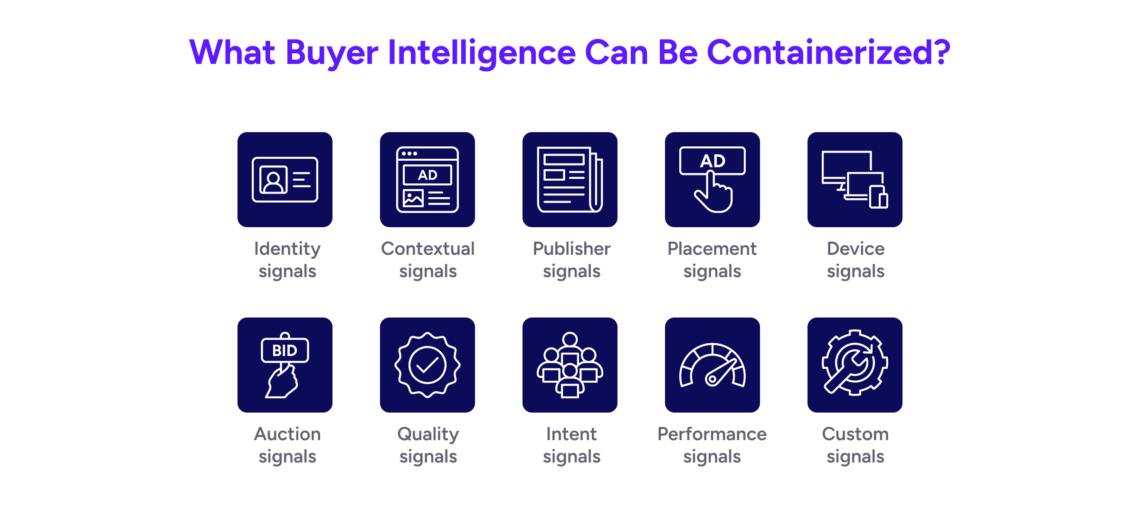
With OpenXBuild™, brands, agencies, and tech partners can bring their own models and decisioning logic directly into the high-volume, low-latency OpenX bidsteam and apply it before the bid request reaches the DSP. The model looks at approved signals like device, inventory, content, geography, and audience indicators, then returns a score or recommendation that helps prioritize which bid requests are sent to the buyer’s DSP of choice.
How Containerization Enables Custom Decisioning
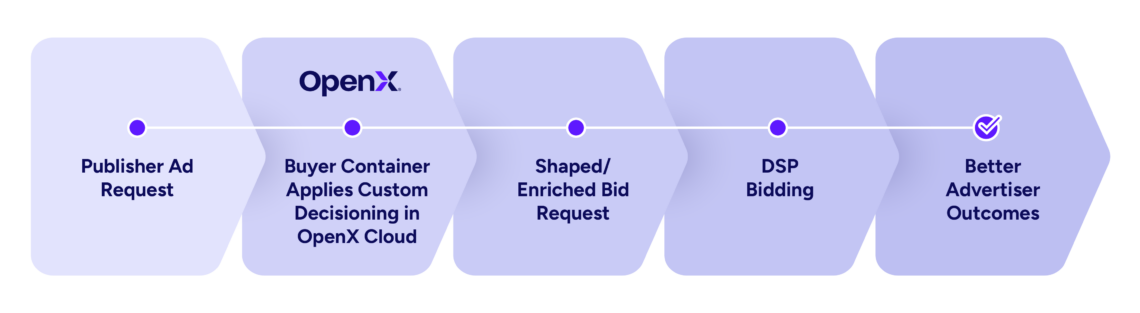
Here’s how the process works:
- A media owner makes an impression available, creating the first signal that an ad opportunity exists. OpenX receives the opportunity and evaluates supply-side signals close to where the impression originates.
- Your agency or brand’s logic enriches the bid request based on the criteria that matters to your campaign: conversion likelihood, audience match, contextual fit, custom business rules, or whatever your model is trained on.
- OpenX calls your agency’s or brand’s container in approximately 5 milliseconds — roughly the time it takes a bee to complete a single wingbeat — applying your custom logic against impression-level data before the bid request reaches the DSP. (By comparison, DSP latency windows have traditionally operated under tight constraints, roughly around 100 milliseconds.)
- Only qualifying bid requests are sent to your DSP via a curated deal ID through OpenXSelect, our curation and supply-side targeting platform.
- Your DSP receives a pre-filtered set of opportunities, reducing unnecessary processing and optimizing bidding on higher-quality results. Your agency or brand avoids low-quality impressions and focuses on opportunities more likely to drive campaign performance.
The best part? Every low-quality opportunity filtered before the bid request reaches the DSP is waste a brand or agency didn’t have to pay for. For example, if OpenX evaluates 1 billion bid requests, and 25% are deprioritized and filtered out upstream, that’s 250 million fewer low-quality opportunities reaching the DSP.
From Cloud Infrastructure to Real-Time Decisioning
While containerization may be a more recent conversation in adtech, it is not new to OpenX. Containers package the code, files, and libraries an application needs to run consistently across environments. OpenX has used containers since our 2019 migration from on-prem servers to a fully cloud-based infrastructure. Our high-volume, low-latency ad serving platform is fully containerized, making it easy for us to dynamically scale up and down with demand.
That experience matters because cloud-native technology and containers go hand in hand: they allow software to run securely, consistently, and at scale across different environments. Now, as buyers and partners bring their own models into our infrastructure to get closer to supply, OpenX is built to support that shift, helping translate buyer intelligence into real-time decisioning inside the bidstream.
Real Use Cases, Real Outcomes
Applying buyer intelligence in this way isn’t theoretical or even a future concept — our partners using OpenXBuild have already seen results:
- Hyundai and Chalice AI saw a 20% lower cost-per-vehicle details page visit and 67% lower CPMs for online video using OpenXBuild.
- tvScientific achieved a 70% reduction in cost-per-conversion on OpenX traffic compared to unshaped SSP inventory.
- Assembly and inPowered AI delivered an 80% decrease in cost per store visit for a national retailer — 98% more efficient than the next closest competitor — using a custom AI model deployed in an OpenXBuild container.
Connect with our team to see how OpenXBuild helps buyers shape the bidstream earlier and drive better outcomes.
About OpenX
OpenX is The Intelligent SSP™ (supply-side platform), simplifying advertising for marketers, advertisers, and publishers worldwide. As one of the largest SSPs globally, OpenX combines the industry’s only fully cloud-based infrastructure with leading AI capabilities to make digital advertising easier and more effective across every format, including CTV. Built to responsibly deliver quality, performance, and adaptability, OpenX makes digital advertising safer, smarter, and built for what’s next. Learn more at www.openx.com.
